PRESS RELEASE
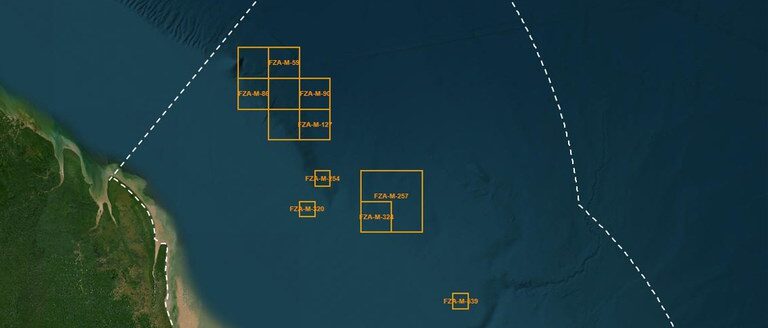
Eight Brazilian civil society organizations and networks filed a lawsuit this Wednesday (October 22) in the Federal Court of Pará against Ibama, Petrobras, and the Federal Government, requesting the annulment of the environmental license which allowed Petrobras to begin drilling for oil at block FZA-M-59, in the Mouth of the Amazon sedimentary basin.
Ibama granted the operating license to the company on the 20th, after four years of pressure from Petrobras and the Ministry of Mines and Energy, in defiance of technical opinions from the institute itself and recommendations from the Federal Public Prosecutor’s Office. Petrobras stated that drilling began immediately after the license was issued.
In the lawsuit, filed in the 9th Federal Court of Belém, Apib (Articulação dos Povos Indígenas do Brasil), Coiab (Coordenação das Organizações Indígenas da Amazônia Brasileira), Conaq (Coordenação Nacional de Articulação das Comunidades Negras Rurais Quilombolas), Confrem (Comissão Nacional para o Fortalecimento das Reservas Extrativistas e dos Povos Extrativistas Costeiros e Marinhos), Greenpeace Brasil, Instituto Arayara, Observatório do Clima, and WWF-Brasil also request an injunction to immediately suspend drilling activities, citing the risk of irreversible environmental damage.
The lawsuit identifies three fundamental flaws in the operating license that render it invalid:
1 – The licensing process bypassed Indigenous peoples and traditional communities – No indigenous Component Study or Quilombola Component Study was conducted during the licensing process. Those are required by Brazilian environmental licensing regulations. Nor was there any free, prior, and informed consultation with Indigenous peoples, quilombolas, and traditional communities that have been affected by the project since the auction of Block FZA-M-59 and its environmental licensing process. In the project area, there are indigenous and quilombola lands, fishing colonies, extractive reserves, artisanal fishing areas, a drainage pipeline, conservation units, and navigation routes.
2 – The licensing process has serious modeling flaws that endanger biodiversity – To obtain Ibama’s license, Petrobras was required to present a modeling study showing what would happen to the oil in the event of an accident, as well as an emergency plan to contain a spill. Both the model used and the data it relies on have flaws that compromise the safety of the operation.
The model does not take into account the characteristics of the region, such as the behavior of subsurface currents, the presence of sediments in the water column, and other factors such as the use of dispersants, which affect the dynamics of oil dispersion and sinking. The lawsuit demonstrates that 20% of the oil spilled in a blowout would sink, potentially reaching the Great Amazon Reef System — a unique, biodiversity-rich ecosystem that also serves as a nursery for fish species vital to the economy and the traditional livelihoods of the Amazon coast.
In addition, Petrobras deliberately used outdated hydrodynamic data from 2013 in the licensing process, even though data from 2024 are already available. Ibama itself required, as a condition of the operating license, that new modeling be presented in the project’s annual report — and yet it granted the license based on a fragile and outdated model, revealing the project’s environmental unfeasibility.
3 – The licensing process ignored the project’s climate impacts – Since 2021, the International Energy Agency has been warning that if humanity is to have any chance of limiting global warming to 1.5°C, no new fossil fuel projects can be licensed anywhere on the planet. Brazil, on the eve of hosting a UN climate conference in the Amazon, mocks the Paris Agreement and COP30 by opening up that same Amazon region to massive expansion of oil production — the main driver of the climate crisis.
Block FZA-M-59, which contains the Morpho well (where drilling has already begun, according to Petrobras), is only the first of a series in the Foz do Amazonas basin. There are eight other blocks currently in the licensing process and 19 auctioned off in the ANP’s June bidding round. Opening a new oil exploration frontier through the approval of Block FZA-M-59 will, in the midst of a climate crisis, increase fossil fuel production — and consequently raise greenhouse gas emissions in Brazil and worldwide.
Statements:
“This project is predatory, it ignores the voice of Indigenous peoples — the true guardians of the forest — and exposes the contradictions of the government in investing in fossil fuels, the main cause of the climate crisis, just days before COP30. In addition to violating the right to free, prior, and informed consent, as established by ILO Convention 169, the licensing process disregarded Funai’s warning about the need to carry out the Indigenous Component Study. We demand the urgent review of this authorization, because the Amazon and its peoples cannot be made to pay the price for a destruction that is not ours.”
— Kleber Karipuna, Executive Coordinator of Apib
“No decision that impacts the lives and territories of Indigenous peoples can be made without listening to those who have cared for the Amazon for millennia. Free, prior, and informed consultation is not a favor; it is a guaranteed and non-negotiable right. Authorizing oil exploration at the mouth of the Amazon without such dialogue is yet another act of violation and disrespect toward Indigenous peoples, who are the ones paying the price for the actions of the State and private sector — both only concerned with profit over life. We demand that our constitutional rights be upheld and that the State and its oversight bodies review the authorizations for this project, which poses serious social and environmental risks to the Indigenous peoples of Amapá.”
— Toya Manchineri, General Coordinator of Coiab
“We have been filing these lawsuits for three years, asking to be heard by Petrobras about this authorization process. What the federal government did through Ibama — granting this license — violates all the rights of the quilombola communities of Amapá and of Brazil, because if there is a spill, it will not only affect the state of Amapá. So, our position here is to demand accountability, because even without the hearing, without the consultation process required by the ILO, the country managed to grant a license to Petrobras. Through the National Coordination of Rural Black Quilombola Communities (Conaq), we denounce the Brazilian government’s action, taken without free, prior, and informed consultation with the quilombola population. Now we will seek allies to defend the Amazon, the quilombola territories, and our Amapá coast — to ensure that no more atrocities and acts of violence take place.
— Núbia Cristina, Quilombola from Amapá and Executive Coordinator of Conaq
“On the eve of COP30, it is regrettable that the Brazilian government has authorized the opening of a new frontier for oil exploration in the Amazon region. The licensing of Block FZA-M-59 disregarded fundamental requirements established in Brazilian environmental law and in international treaties to which the country is a signatory. The annulment of the operating license is urgent, as it was granted without studies that properly identify and mitigate socio-environmental risks and impacts — such as those affecting the Great Amazon Reef System — without an assessment of climate impacts, and without conducting free, prior, and informed consultation with Indigenous peoples, quilombola communities, and traditional populations. Brazil must reaffirm ambitious climate commitments and ensure the effective respect for human rights so that we can guarantee a viable future, based on environmental protection, the appreciation of peoples and communities, and the preservation of their socio-environmental wealth.”
— Angela Barbarulo, Legal Manager at Greenpeace Brasil
“It is unacceptable that a project of this magnitude advances without free, prior, and informed consultation with the Indigenous, quilombola, and fishing communities that will be directly affected. This is an affront to the Constitution and to ILO Convention 169. Petrobras proclaims itself a leader of a just energy transition, yet it is responsible for 29% of all fossil fuel expansion in Latin America. There is no justice when peoples and territories are sacrificed. Ibama and Funai themselves have already acknowledged the impacts on traditional communities. Ignoring this is to turn a blind eye to science and to the law. We already have clear precedents in Brazilian courts: any environmental license granted without consultation is null. What is at stake here is respect for the rule of law and for environmental democracy.”
— Nicole Oliveira, Executive Director of Instituto Arayara
“In the midst of the climate crisis and on the eve of COP30, Brazil throws away its attempt to lead by example and jeopardizes its climate legacy by authorizing the drilling of Block FZA-M-59 in the Foz do Amazonas basin, laying the groundwork for the occupation of the region by the oil industry. The licensing process contains several technical and legal inconsistencies that irrefutably demonstrate the inadequacy of the license issued by Ibama. There are weaknesses in the modeling, violations of ILO Convention 169, and other serious issues. Instead of protecting ecosystems and the climate system and upholding the Federal Constitution, drilling was irresponsibly authorized. There is no other appropriate measure than to file a lawsuit.”
— Suely Araújo, Public Policy Coordinator at Observatório do Clima
“Granting a license for oil exploration at the mouth of the Amazon without proper proof of environmental and social safety constitutes a serious violation of the precautionary principle and of the duty of environmental progressivity — both fundamental pillars of Brazilian Environmental Law. Several recommendations from the Federal Public Prosecutor’s Office were ignored during the environmental licensing process, which presented significant technical inconsistencies. In the face of such a sensitive, biodiverse, and interconnected ecosystem, scientific uncertainty should be a reason for caution, not for advancement. The Brazilian State has the constitutional duty to guarantee an ecologically balanced environment, and this includes preventing activities that endanger unique ecosystems such as that of the Amazon River mouth. Authorizing oil exploration without complete and participatory studies opens the door to irreversible harm to biodiversity and to the communities that depend on this territory.”
— Danilo Farias, Strategic Litigation Coordinator at WWF-Brasil
Press Contacts
Apib
Samela Sateré Mawé +55 92 98285-5077
Yago Kaingang/Fulni-ô +55 43 98865-1166
Ariel Bentes +55 92 99430-3762
comunicacao@apiboficial.org
Coiab
Valdeniza Vasques +55 92 99430-8387
comunicacao@coiab.org.br
Greenpeace Brasil
Agência Galo
Thiago Rebouças +55 11 98562-3094
Milka Verissimo +55 11 95761-2703
Tales Rocha +55 11 98870-1089
imprensa.br@greenpeace.org
Instituto Arayara
Luz Dorneles +55 61 99624-9702
luz.dorneles@arayara.org
Observatório do Clima
Solange Barreira +55 11 98108-7272
solange@pbcomunica.com.br
WWF-Brasil
Agência Aviv +55 11 91780-0526
Sandra Miyashiro (sandra.miyashiro@avivcomunicacao.com.br)
Rita Silva (rita.silva@avivcomunicacao.com.br)
cc: comunicacao@wwf.org.br